 Gloria Davis
Can a low-growing stonecrop cover a sunny, dry garden without hiding its character? Yes: the creeping spurium stonecrop forms a mat of fleshy leaves and seasonal flowers where soil drains freely. The tricolored sedum offers a patterned carpet, while ‘John Creech’ gives a greener, denser effect. Both reward a close look at the soil before planting.
These are two distinct cultivars of the same species, not interchangeable names. Their leaves set the tone of a planting long before the flowers appear, and their creeping stems make them useful at the edge of a path or among stones.
One species, two names
The plant is commonly called two-row stonecrop or Caucasian stonecrop. North Carolina State Extension uses the botanical name Phedimus spurius for the species; older references and nursery labels may use its former name. Searching under both names can help you find the plant, but the cultivar name on the label is equally important when you want a particular leaf color.
It is a perennial succulent with low, spreading stems and small fleshy leaves. As stems meet soil, they can root and extend the mat. The species comes from a region extending from northeastern Turkey to northern Iran, so it is not a native groundcover in North America. Its flowers attract pollinators, but a garden designed to support local insects can also include regionally native flowering plants with different bloom times.
Sedum tricolor and its patterned foliage
Among forms of sedum spurium, Tricolor has green leaves edged and marked in cream or white and pink, as University of Illinois Extension notes. The pink coloring is strongest in full sun. Small pink flowers rise above the foliage in summer. This is a plant for someone who wants the leaves themselves to bring contrast to a dry border, even when the flowers have faded.
The low-growing sedum tricolor fits a dry border; check the full species and cultivar on the label before buying. The Tricolor cultivar of spurium stonecrop shares the creeping habit of other forms, but a single plant will take time to fill open ground. North Carolina State describes the species generally as about 2 to 6 inches tall and 2 to 3 feet wide; actual coverage depends on the plant, soil, and time allowed. Those figures are a guide to the species, not a precise promise for every individual.
Place it where its pale margins can be seen against stone, darker foliage, or bare soil. Give it enough light to develop its coloring and enough space that neighboring plants do not quickly shade it. Where all-green shoots appear, removing them can help preserve the variegated display.
A denser green carpet
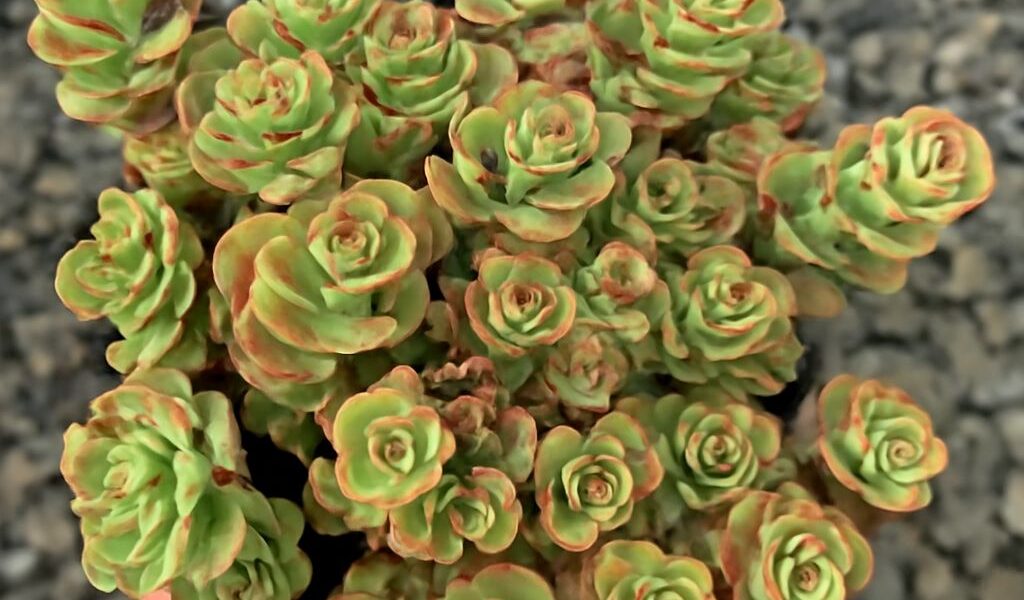
Among varieties of sedum spurium, John Creech forms a dense mat of small green leaves, with pink star-shaped flowers later in the season. North Carolina State’s cultivar profile describes flowers from August to September and foliage that can turn burgundy in fall. The plant remains evergreen in warm-winter climates, while its appearance changes with colder conditions.
The same profile lists foliage roughly 1 to 3 inches high and 6 to 12 inches wide in its dimensions, while its descriptive text notes that spreading stems can eventually reach about 24 inches. Treat these as different stages or estimates rather than a fixed boundary: watch the edges and trim or lift rooted pieces if they travel beyond the space you intend to cover.
For either selection, a series of small plants can fill a bed more evenly than a single plant placed in the middle. Leave room for them to spread, and keep weeds out while the gaps are still open. Once a mat has formed, weeds are harder to remove without disturbing its shallow growth.
Light, soil, and the seasons
Choose a site with full sun and good drainage. Both selections can tolerate some shade, but stronger light supports the colorful foliage of the variegated form. Soil that remains wet after rain is a poor match: roots need air, and persistent moisture can encourage rot. Sandy or gravelly ground, a well-drained slope, or the upper edge of a rock garden offers water a route away from the roots.
If the intended bed is heavy clay and puddles linger, choose another location or build a genuinely well-drained raised bed rather than placing a little gravel in the planting hole. Observe where rainwater goes before planting. Water new plants as they establish, letting the soil dry between waterings; established plants tolerate dry spells, though a prolonged drought may still call for attention. Avoid heavy fertilizer, which can encourage soft, less compact growth.
For climate planning, North Carolina State lists zones 4 through 8 for ‘John Creech’; local exposure and winter wetness also matter. A hardiness zone describes average winter lows, not drainage or summer conditions. Where summers are intensely hot, some afternoon shade may be helpful, but expect less vivid variegation than in full sun.
For a sunny bed of freely draining sandy soil, choose the variegated cultivar if leaf color is the priority. In a similarly drained spot with sun or light shade, choose ‘John Creech’ for its compact green mat and later pink flowers. Either choice begins with a place where water can leave the roots.