 Gloria Davis
A hydrangea can produce a mass of green leaves and few flowers even when nutrients are plentiful. Too much nitrogen can encourage leafy growth at the expense of blooms, so the first decision is whether the shrub needs feeding at all.
The right time to feed hydrangeas follows that assessment. Look at the plant, its soil and the season before adding fertilizer; a healthy shrub growing in reasonably fertile ground may need little or none.
Fertilizing Hydrangeas Starts With a Soil Check
A soil test provides a clearer picture of pH and available nutrients than leaf color alone. Contact your local cooperative extension office for a testing service and follow its sampling directions. Collect soil from around the root area as instructed, avoiding recently fertilized patches. Use the report’s recommendations for your planting bed rather than adding a product simply because the plant has not flowered.
Yellowing, slow growth or sparse flowers can have several causes. Waterlogged roots, drought, unsuitable soil pH, too much shade, winter injury and pruning at the wrong time may all affect a shrub. Feel the soil and inspect the leaves and stems before treating a symptom as a nutrient shortage. University of Maryland Extension describes several such causes and notes that excess nitrogen can reduce flowering.
For established shrubs in suitable soil, fertilizing hydrangeas is most useful when a test or local horticultural guidance indicates a need. Compost as a surface mulch can contribute organic matter gradually, but it is not a precise substitute for a soil-test recommendation. Keep mulch away from the stems and leave water able to reach the roots.
Match feeding to growth and local weather
When to fertilize hydrangeas depends on the climate and on whether a product is needed. For an established shrub, spring is a common opportunity, as the soil warms and the growing season begins. University of Massachusetts Extension discusses spring feeding for hydrangeas; local extension advice can help adapt that timing to your region.
Deciding when to fertilize a hydrangea also depends on local warmth: spring feeding may start earlier in a mild region than where the ground remains cold. Follow the plant and local conditions instead of relying on a national calendar date. Avoid applying fertilizer to drought-stressed shrubs: water appropriately and allow the plant to recover first. Fertilizer cannot replace moisture at the roots.
Late-season nitrogen can encourage tender growth that may be injured by an early frost. For example, University of New Hampshire Extension cautions against high-nitrogen fertilizer in late summer. Regional advice differs with climate and product, so consult your local extension service and the label before any later application. If a shrub is healthy and the growing season is nearly over, waiting for spring is a reasonable choice. The best season for feeding hydrangeas is the one that meets a demonstrated need while allowing growth to mature before cold weather.
Choose a product and apply it carefully
A fertilizer label lists nitrogen, phosphorus and potassium in that order. Select a formulation suited to the soil-test recommendation and appropriate for shrubs. A balanced product may be appropriate where feeding is advised; more phosphorus is not automatically better for flowers, particularly if the soil already contains enough. Excess nutrients can leave the garden in runoff as well as harm plants.
How to fertilize hydrangeas safely begins with the product label: follow its directions for the plant, application area, amount, timing and watering. Spread a granular product over the root area as directed rather than piling it against the stem. Water it in if the label calls for it, and keep granules off hard surfaces where rain could carry them toward drains.
When feeding a hydrangea, measure rather than guessing, and do not combine products without accounting for nutrients already supplied. Slow-release and liquid fertilizers deliver nutrients at different rates, so their labels are not interchangeable. Keep the package information and the date of application in your garden notes.
Containers and flower color need separate attention
A potted shrub has a limited volume of mix, and repeated watering can carry nutrients out through the drainage holes. Check whether the potting mix already contains fertilizer and how long it is intended to last. Then choose a product labeled for container plants and follow its instructions. Water until excess drains, and avoid leaving the pot standing in water. Check moisture more often during hot or windy weather than during cool, damp periods.
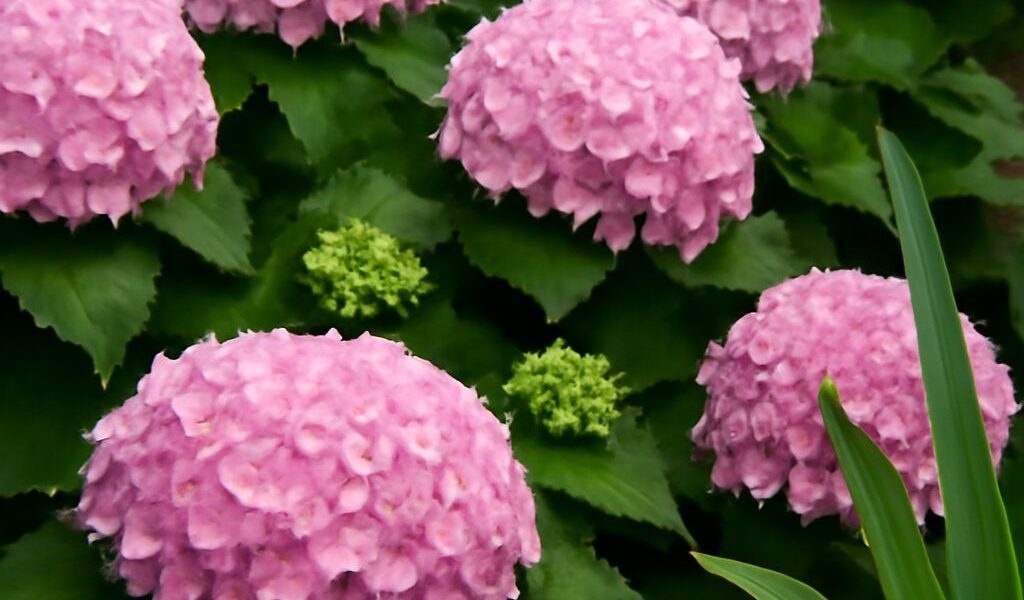
Flower color is a different question from whether a plant needs feeding. Some bigleaf and mountain hydrangea cultivars can produce blue or pink flowers as soil chemistry changes; white cultivars generally do not change color this way. A soil test and the cultivar’s identity are starting points before using any pH amendment. UMass Extension notes that the amount needed to alter pH varies with existing pH and soil type.
Before choosing the next feeding date, assess the shrub’s growth, feel the soil and review a soil test or the potting mix label. If the plant and soil have what they need, wait; if feeding is indicated, choose a locally appropriate time and follow the product directions.