 Gloria Glover
 Milkweed caterpillars need living milkweed foliage; adult butterflies pollinate flowers while seeking nectar, and a bee balm flower supplies a valuable nectar source rather than caterpillar food. A useful planting therefore pairs host milkweed with nectar-rich plants such as bee balm, keeping each plant’s role clear.
We can identify the main milkweed visitors by their markings and body covering. Monarchs and queens are butterflies, while the milkweed tussock moth is a moth with a very different appearance and life cycle.
Milkweed Caterpillars: Identify Monarchs, Queens, and Tussock Moths
Monarch versus queen caterpillars
Monarch caterpillars have alternating black, white, and yellow bands with two pairs of long black filaments, one pair near the front and one near the rear. They usually feed alone or in small groups and may consume substantial amounts of milkweed before forming a chrysalis.
Queen caterpillars also use milkweed and resemble monarch larvae, but they typically have three pairs of filaments. Their black bands often appear broader, and the warm brown or reddish tones between the bands can be more noticeable. Because both species vary slightly by age and lighting, we should use filament number and overall pattern together rather than relying on color alone.
Milkweed tussock moth caterpillars
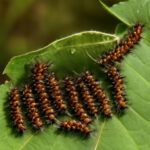
Milkweed tussock moth caterpillars are covered with tufts of black, white, orange, or yellow hairs. They often feed in groups and can leave sections of milkweed foliage stripped. They are not monarchs or queens, and they become moths rather than butterflies. Their conspicuous coloring signals chemical protection gained from milkweed, just as milkweed compounds help make some monarch and queen larvae distasteful to predators.
How Butterflies Pollinate Flowers
How feeding moves pollen between flowers
When a butterfly lands on a flower, its legs and body can brush against the anthers, the pollen-producing structures. Pollen grains adhere to those surfaces as the butterfly reaches into the bloom with its long proboscis. When it visits another flower of the same species, the pollen may contact that flower’s stigma, allowing fertilization.
Butterflies commonly move among scattered flowers and can carry pollen farther than a single short feeding trip. Their effectiveness depends on flower shape, pollen placement, and how often they visit the same plant species. Nectar feeding, not caterpillar feeding, drives this adult pollination service.
Bee Balm Flower as an Adult Nectar Source
Identification, bloom, and care
Bee balm, or Monarda, is a mint-family perennial with square stems, opposite leaves, and rounded heads of tubular flowers. Blooms may be pink, red, purple, or white and usually appear from early to midsummer, with some cultivars continuing after trimming. Plant it in full sun to light shade and moist, well-drained soil. Good air circulation helps reduce powdery mildew; dividing crowded clumps also maintains vigor.
Nectar value for adult butterflies, not caterpillars
The tubular flowers hold accessible nectar for many adult butterflies, along with bees and hummingbirds. Bee balm is an adult food plant, not a milkweed host plant: its leaves do not replace milkweed foliage for monarch, queen, or tussock moth larvae. Deadheading can encourage additional bloom, but leaving some seed heads provides structure and food for wildlife.
Combining Host and Nectar Plants
Match milkweed foliage to bee balm nectar
Choose milkweed species suited to the site, such as common milkweed for drier soil or swamp milkweed for consistently moist ground. Plant several milkweed stems together so females can find host foliage, then place bee balm nearby for adult nectar. Leave enough space for air movement and for caterpillars to feed without exhausting every plant.
Plan sun, bloom succession, and pesticide-free shelter
Arrange the bed for at least six hours of sun where possible, and combine bee balm with other nectar plants that bloom before and after it. Avoid insecticides on host and nectar plants, including treatments that can persist in plant tissue. Keep some leaf litter, hollow stems, or low vegetation nearby, giving resting and overwintering insects shelter alongside the living milkweed and flowering bee balm.