 Gloria Glover
 Tropical rainforest plant adaptations in Africa reflect a vertical contest for light, water, and minerals. The continent’s main tropical rainforests lie in the Congo Basin and neighboring Guinea-Congolian forests of West and Central Africa, with another important belt along Madagascar’s humid eastern escarpment. These are not all African forests: savannas, dry woodlands, and montane grasslands have different climates and plant communities. In the wettest rainforest zones, year-round warmth combines with roughly 1,500–3,000+ mm of rain annually, although coastal and montane areas have stronger wet-dry or elevation patterns.
Where rainforests in Africa occur: Regions and climate
The largest rainforests in Africa form the Congo Basin’s continuous lowland block, stretching across countries including the Democratic Republic of the Congo, Republic of the Congo, Gabon, Cameroon, and the Central African Republic. West Africa’s Upper Guinean forests and the Lower Guinean forests along the Gulf of Guinea are more fragmented, while eastern Madagascar supports distinct humid evergreen forests. Equatorial lowlands stay hot, cloudy, and humid, with rainfall often distributed across many months. Near seasonal margins, a longer dry season changes canopy behavior and favors deciduous or drought-tolerant species; altitude also cools and simplifies forest structure.
The canopy layer of the rainforest: Light, moisture, and activity
The canopy layer of the rainforest is the broad, interlocking roof formed by mature tree crowns, usually about 25–40 metres above ground in lowland forest. Emergent trees rise above it, sometimes 50–60 metres, and receive the strongest sun and wind. Below, the understory may occupy roughly 5–15 metres, followed by a dim shrub and seedling layer and the forest floor. Each level changes a plant’s options. Upper leaves receive intense light but dry quickly after rain; lower levels remain warmer, calmer, and more humid, yet often receive only a small fraction of sunlight filtered through several leaf layers.
The canopy is also a center of biological activity. Flowers and fruit attract insects, birds, primates, and bats; leaves power most of the forest’s carbon gain; and branches support ants, spiders, frogs, and epiphytes. Rain does not reach every root evenly: foliage intercepts showers, trunks channel water downward, and exposed branches can lose moisture quickly. This patchy supply makes canopy gaps especially valuable. When a tree falls, sunlight reaches the ground and fast-growing herbs, vines, and pioneer trees compete to occupy the opening.
Life in the upper canopy
Life in the upper canopy depends on a plant’s ability to reach light without losing too much water. Trees extend crowns into gaps, while lianas use established trunks as living supports. Branches become suspended habitat: orchids, ferns, mosses, insects, birds, and arboreal mammals feed or shelter there. Flowers and fruits are concentrated resources, so canopy plants often time reproduction when pollinators and seed dispersers are active. A fallen tree briefly reverses these conditions; the resulting gap lets sun-loving pioneers grow rapidly before taller crowns close overhead.
Tropical rainforest plant adaptations by layer
From canopy to forest floor, adaptations match the local balance of light, water, and nutrients.
- Heavy rain: Drip tips, waxy surfaces, and angled leaves shed water, limiting fungal growth and keeping leaf pores functional.
- Low light: Broad, thin, dark-green shade leaves capture weak light; seedlings often grow slowly until a canopy gap opens.
- Climbing: Lianas use twining stems, hooks, tendrils, or adhesive roots to reach the canopy without building a thick self-supporting trunk.
- Epiphytic growth: Orchids, ferns, and mosses live on branches rather than in soil, using aerial roots, trapped leaf litter, and specialized tissues to collect water and minerals.
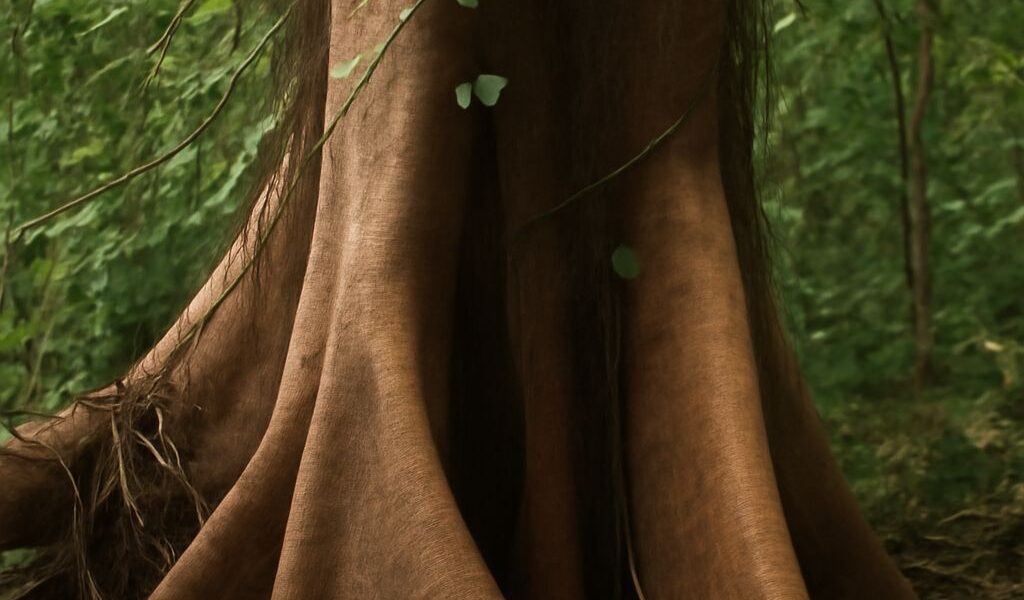
- Nutrient competition: Buttress roots stabilize tall trees in shallow soils, while spreading surface roots and mycorrhizal fungi capture scarce minerals before heavy rain leaches them away.