 Gloria Glover
 Desert recovery after fire, grazing, mining, or flash flooding does not happen all at once. The stages of ecological succession describe how organisms colonize a disturbed site, change its soil and shelter, and create opportunities for other species. In a desert, limited water makes this process slow and strongly seasonal.
To understand a desert food chain, we can track energy from the first photosynthetic producers to increasingly varied consumers as plant cover and habitat develop. The key distinction is whether soil remains after disturbance.
Primary and Secondary Succession: The Stages of Ecological Succession
Primary succession: bare substrate, pioneer species, soil building, and community development
Primary succession begins on bare rock, newly exposed mineral sediment, or another surface with little organic matter. Its stages are:
- Bare substrate: Few nutrients and almost no shelter limit colonization.
- Pioneer colonization: Hardy photosynthetic organisms establish and begin capturing energy.
- Soil building: Their remains, trapped dust, and microbial activity add organic matter and improve water retention.
- Community development: Annual plants, grasses, shrubs, and consumers arrive as resources and shelter increase.
Secondary succession: surviving soil, rapid regrowth, and renewed competition
Secondary succession follows a disturbance that removes much of the visible vegetation but leaves soil, roots, seed banks, microbes, or plant fragments. Annual plants may return first, followed by perennial grasses and shrubs. Competition for water and light then increases. Drought, erosion, repeated disturbance, or invasive species can redirect the sequence, so succession does not always lead to one fixed endpoint.
Desert Ecosystem Producers During Recovery
Pioneer traits: drought tolerance, rapid growth, and effective seed dispersal
Important ecosystem producers include cyanobacteria and lichens in biological soil crusts, desert annuals, perennial grasses, creosote bush, sagebrush, cacti, and palo verde trees. Pioneer producers tolerate intense sunlight, heat, drying, and nutrient-poor substrate. Some remain dormant as seeds until rain arrives; others spread through wind-dispersed seeds or shallow roots that quickly absorb brief rainfall. Cacti and some shrubs conserve water through specialized tissues or nighttime gas exchange. As these producers increase, they add food, shade, litter, and nesting sites.
A Desert Food Chain Through Succession
Bare ground: photosynthetic crusts to insects to lizards
In an early recovery patch, a simple chain might begin with cyanobacteria and other photosynthetic soil-crust organisms, continue to small insects or grazers, and end with an insect-eating lizard. Energy enters through photosynthesis, while the crust also helps stabilize soil against erosion.
Sparse cover: annual plants to rodents to snakes
After seasonal rain, annual grasses and wildflowers produce seeds and green tissue. A representative chain is annual plants → kangaroo rats → gopher snakes. Rodents gain food and limited cover, while snakes gain a more reliable prey source. Seed-eating birds and insects may join the same pathway.
Shrub patches: grasses and shrubs to herbivores to foxes and raptors
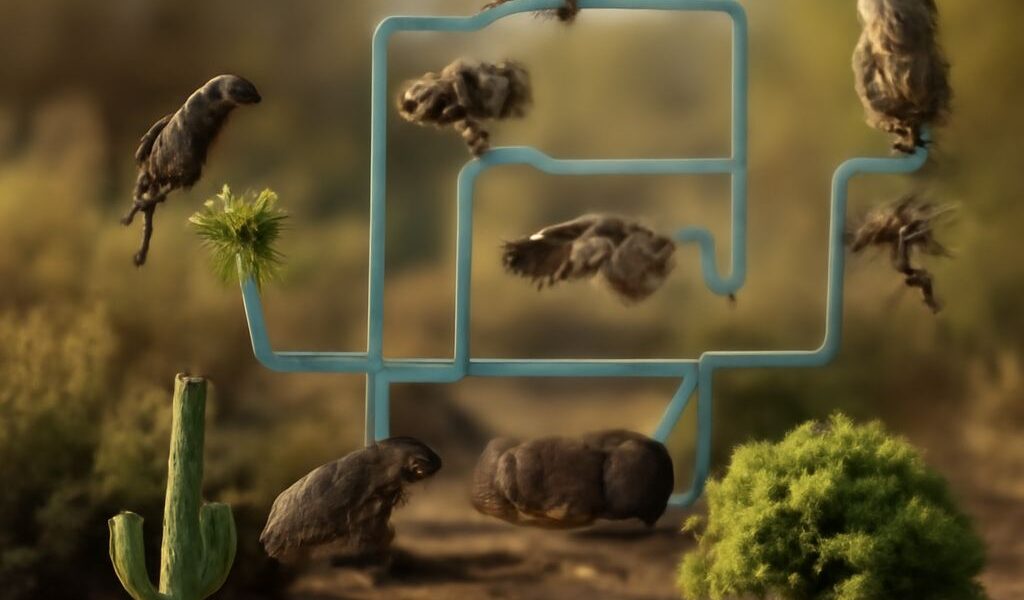
With deeper soil and more persistent vegetation, grasses, shrubs, and cacti support grasshoppers, jackrabbits, rodents, and browsing insects. Kit foxes may prey on rodents, while hawks and owls hunt rodents, lizards, or snakes. More producers therefore support several linked chains rather than one straight sequence.
How Succession Changes the Food Web Without a Fixed Endpoint
Succession usually increases the amount and variety of available energy, but not in a perfectly predictable direction. More plant layers create feeding sites, hiding places, and nesting habitat. Litter also supports decomposers and detritivores, adding a detrital pathway alongside live-plant feeding. Seasonal drought, fire, grazing, and rainfall can maintain a shifting mosaic of bare ground, annual patches, and mature shrubs. The resulting desert food web reflects current conditions rather than a permanently final community.