 Gloria Glover
 Choose among milkweed types by matching the plant to soil moisture, sunlight, and available space. Butterfly milkweed suits hot, dry, well-drained sites, while swamp milkweed belongs in consistently moist ground and common milkweed handles a broader range of conditions.
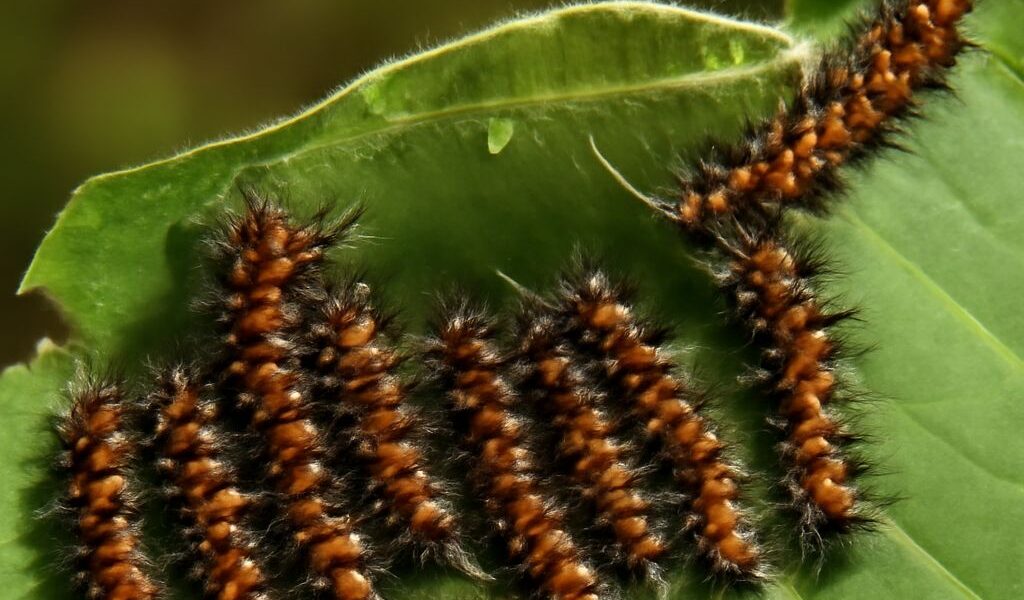
The milkweed tussock caterpillar is a hairy moth larva that feeds openly on milkweed leaves, often in groups. Its black, white, and orange bristled tufts distinguish it from the smooth, banded monarch caterpillar.
Milkweed Types for Different Habitat Conditions
Common milkweed: widespread eastern and central range, dry-to-mesic soils, and tall spreading colonies
Common milkweed (Asclepias syriaca) is native across much of eastern and central North America. It grows 3 to 6 feet tall in dry to moderately moist soil and spreads by underground rhizomes, forming broad colonies. We use it where space is available and a naturalized, vigorous growth habit is acceptable.
Swamp milkweed: moist soils, wet meadows, and tall clumping growth
Swamp milkweed (Asclepias incarnata) prefers consistently moist soil, rain gardens, stream edges, and wet meadows. Its upright stems generally reach 3 to 5 feet and grow in clumps rather than aggressively spreading colonies.
Butterfly milkweed: dry well-drained sites, compact 1- to 3-foot growth, and a deep taproot
Butterfly milkweed (Asclepias tuberosa) is native through much of eastern and central North America. It tolerates heat and drought after establishment, stays relatively compact, and suits sunny borders, prairies, and sandy or rocky soil.
Whorled milkweed: dry prairie soils, slender foliage, and lower-growing branching stems
Whorled milkweed (Asclepias verticillata) occurs widely across central and eastern prairies. Its narrow leaves circle slender stems, which typically grow 1 to 3 feet tall in dry, well-drained soil. It offers a lighter, less imposing alternative to common milkweed.
Butterfly Milkweed Plants: Identification and Care
Key traits: orange flower clusters, narrow leaves, and little to no milky latex
We can identify butterfly milkweed by its vivid orange, flat-topped flower clusters, narrow lance-shaped leaves, and upright branching stems. Unlike many milkweeds, its stems usually produce little or no visible milky latex when cut. It develops a thick taproot, so transplanting mature plants can be difficult.
Care needs: full sun, sharply drained soil, and minimal disturbance after establishment
Plant butterfly milkweed in full sun and sharply drained soil. Avoid heavy watering and rich, constantly wet beds. Water regularly during the first growing season, then reduce irrigation once roots are established. Leave its stems until late winter when possible, and avoid disturbing the root zone.
Identifying the Milkweed Tussock Caterpillar
Appearance and life stage: a hairy black, white, and orange larva of a tiger moth
The milkweed tussock caterpillar is the larval stage of the milkweed tussock moth, a tiger moth often identified as Euchaetes egle. Young larvae may appear mostly orange and black; mature larvae develop conspicuous tufts of black, white, and orange hairs along the body.
How it differs from a monarch caterpillar: bristled tufts instead of smooth banded stripes
Monarch caterpillars have smooth bodies marked by repeated black, white, and yellow bands, plus two pairs of long black filaments. Tussock caterpillars look fuzzy and tufted rather than smoothly striped. We should identify the body texture and pattern before calling any milkweed-feeding caterpillar a monarch.
Feeding Signs and the Caterpillar’s Relationship With Milkweed
Host use and feeding pattern: gregarious leaf chewing that can create ragged holes and skeletonized patches
Milkweed tussock caterpillars commonly feed gregariously, especially when young. Groups chew irregular holes between leaf veins, then may leave partially skeletonized patches as they grow. Look on leaf undersides, stems, and nearby foliage for clusters of hairy larvae and dark frass.
Why milkweed matters: a seasonal host plant that supports tussock moth development and recovers from partial defoliation
Milkweed is the caterpillar’s host plant and supplies food during its larval development. Although a large group can remove noticeable foliage, established milkweeds generally tolerate partial defoliation and continue growing. We can usually leave the caterpillars in place unless feeding threatens a small, newly planted specimen.