 Gloria Davis
Will the cheerful blooms of coreopsis return every spring? Some will, if their growing conditions suit them; others complete their lives in one season and return only if new seeds germinate. Perennial forms of coreopsis and their annual relatives can look much alike, so the name on the label matters as much as the color in the bed.
Known commonly as tickseed, this group offers plants for different spaces and seasons. Reading the botanical name, expected height, and soil requirements gives you a better picture of what will grow than a photograph of a single blossom can provide.
Coreopsis Perennial or Annual: What the Label Tells You
A perennial lives for more than two years, although its aboveground growth may die back seasonally. An annual grows, flowers, sets seed, and completes its life cycle in one growing season. A coreopsis perennial can return from its own established plant; an annual may appear in the same place next year because its seeds have sprouted. Those seedlings are new plants.
For example, plains tickseed (Coreopsis tinctoria) is an annual. North Carolina Extension lists it at 2–4 feet tall, with flowers from summer into fall and a preference for full sun. Its branching stems suit an open, sunny planting where there is room for a taller display. It can self-seed on bare ground, so decide whether you want to leave some seed heads or remove spent blooms before seed develops.
Lanceleaf tickseed (Coreopsis lanceolata), by contrast, is a perennial. North Carolina Extension describes a plant typically around 2 feet tall, with yellow rays that are conspicuously notched at their tips. Its flowers generally open in spring and early summer. Its narrow leaves and flower shape are clues, but consult a reliable plant description and label before making an identification.
Species, Cultivars, and Color
A species name identifies a botanical species. A cultivar is a named selection or cultivated plant chosen for particular characteristics; its name usually follows the botanical name in single quotation marks. Among coreopsis varieties, Coreopsis pubescens ‘Sunshine Superman’ is a compact example. North Carolina Extension describes the selection as about 10–12 inches tall and 6–8 inches wide, with yellow flowers in summer. It favors full sun and well-drained soil and tolerates dry conditions once established.
Another named selection, Anacis verticillata ‘Moonbeam’, formerly classified as Coreopsis verticillata, has fine foliage and a mounding habit. North Carolina Extension describes it as 1–3 feet tall, with pale yellow flowers through summer in sun and well-drained soil. The cultivar name helps distinguish it from other selections, whose size and appearance can differ.
If you are looking for orange coreopsis, begin with more than the color printed on a tag. A 2022 UC Davis Arboretum inventory describes the selection ‘Orange Elf’ as bearing orange flowers with yellow edges and centers from summer into fall. That combination is a useful clue, not a species diagnosis. Compare foliage, mature height, bloom time, and the full botanical name with the plant you are buying. Color can vary with selection and growing conditions, and similar colors occur across different plants.
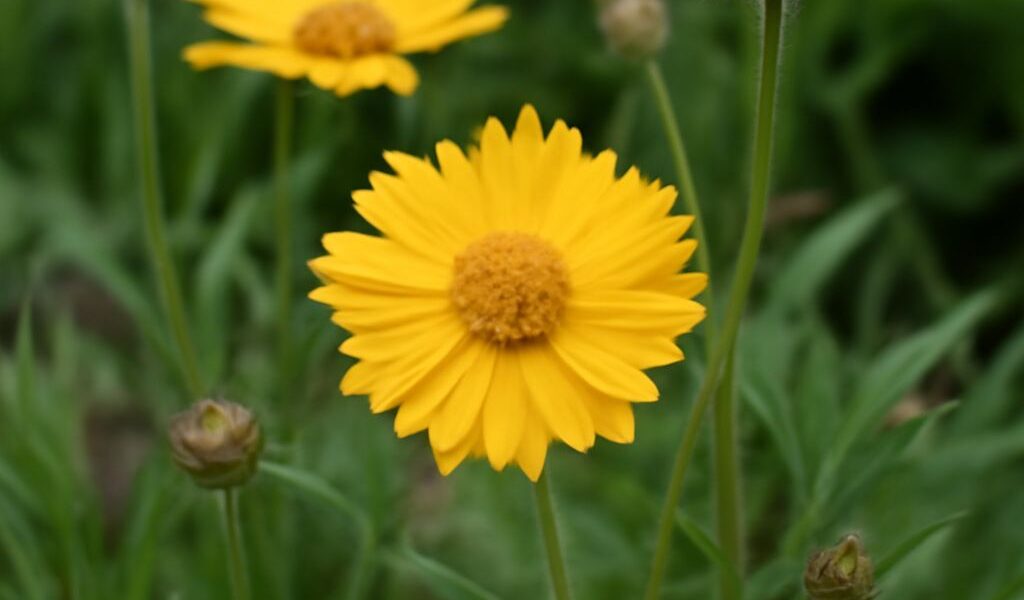
Look closely at a coreopsis flower and the apparent single bloom resolves into a head of smaller florets: outer rays surround a central disk. That structure is shared with other members of the daisy family. Tickseed blooms can offer visiting insects nectar and pollen, while seed heads left later in the season can feed birds. If you deadhead for more flowers, you can leave some later heads standing for seed and wildlife.
Match the Roots to the Site
Many familiar selections grow best in full sun and soil that drains well. Before planting, notice how the bed behaves after rain: if water remains around roots for long periods, choose a better-drained place for ‘Sunshine Superman’ or lanceleaf tickseed. Allow enough room for the mature width on the label, rather than setting small nursery plants edge to edge. Water new plants during establishment; after they are rooted, adjust watering to the species and the soil instead of keeping a dry-site plant continually wet.
The genus also includes plants for moister ground. North Carolina Extension describes coastal plain tickseed (Coreopsis gladiata) as a perennial for moist to occasionally wet, acidic sandy soil. It reaches roughly 2–2½ feet tall, accepts full sun or partial shade, and flowers in early fall. Its southeastern origin and listed hardiness zones of 7–10 are useful checks before choosing it for a colder garden.
To compare different types of coreopsis, start with the site you actually have. For a dry, sunny, well-drained border, choose compact ‘Sunshine Superman’ and give it room to spread. For a sunny or partly shaded patch with moist, acidic sand in a suitable warm climate, choose C. gladiata. In either place, watch the coreopsis blossoms and the soil through the season: together they reveal whether the choice fits its ground.