 Gloria Davis
How frequently should a moth orchid be watered? There is no fixed interval that suits every home: check the growing mix and the plant before deciding. Watering is due as the mix dries, and the time that takes changes with the pot, the season, and the room around it.
An orchid’s roots need both moisture and air. A thorough drink followed by good drainage can provide both; a pot left standing in water can leave roots wet for too long. Begin by finding the name on the plant’s label, since different orchids store and use water differently.
When to Water Orchids: Start With the Mix
Knowing when to water orchids begins with a small investigation. For a common moth orchid, or Phalaenopsis, touch the bark or moss below the surface. Iowa State University Extension recommends watering a moth orchid as the growing medium dries. A dry-looking top can conceal damp material underneath, especially in a tightly packed moss pot, so check inside rather than relying on the surface alone.
A clean wooden chopstick can reach farther into a coarse mix. Leave it in briefly, then remove it and feel whether it is damp. The extension also suggests a dry chopstick, lighter-colored medium, and a lighter pot as signs that the mix has dried. Lift the pot after a thorough watering and again as it dries to learn the difference. If the interior is still wet, wait and check again.
How often should I water my orchid? The answer follows from those observations. One plant might dry quickly on a bright, warm windowsill, while another in a cooler room remains damp much longer. Check regularly at first; over time, the pot’s weight and the feel of its contents will become familiar.
Different Roots, Different Rhythms
Moth orchids lack the swollen water-storing stems called pseudobulbs. Water them as the medium dries, before they suffer a prolonged dry spell. Cattleya orchids have pseudobulbs and generally tolerate a drier interval: North Carolina Extension advises allowing their medium to dry completely between waterings. The label’s genus gives you a starting point, while the condition of the actual pot tells you what to do today.
Visible roots can add another clue. Healthy moth orchid roots are firm and may look silvery or white when dry, then turn green when wet. Soft, brown roots can indicate poor root health. A silvery aerial root alone does not prove that the middle of the pot is dry, however; combine what you see with a check of the mix. Wrinkled leaves can signal water stress, but persistently wet mix and damaged roots call for attention to drainage, not simply another drink.
How to Give a Thorough Drink
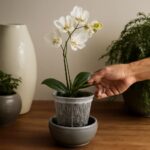
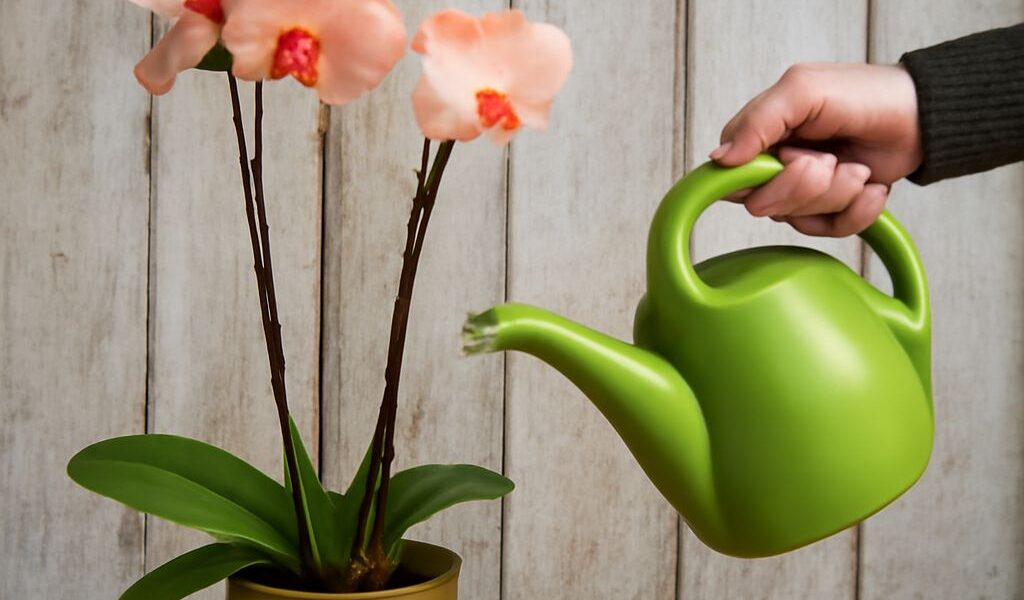
How do you water an orchid once the mix is ready? Take its inner pot to a sink and use room-temperature water. Run water over the medium until it is thoroughly moistened and water flows from the drainage holes. Avoid wetting the leaves and crown, where trapped water can linger. Iowa State Extension suggests repeating the watering after a few minutes so the medium absorbs water more fully.
Let the pot drain completely before returning it to its decorative container. Empty any saucer or outer pot; roots should never sit in the collected water. Holes in the growing pot are essential. If a decorative vessel has no holes, use it only as an outer cover and remove the draining inner pot for each watering. A humidity tray can hold pebbles and water beneath the pot, but keep the pot’s base above the water line.
This is how to water orchids indoors without leaving a reservoir around their roots. Coarse bark usually drains and dries faster than sphagnum moss, which holds more water. Neither material should be watered on a schedule borrowed from a different pot. A compacted or decomposed mix can hold too much moisture and restrict air; University of Maryland Extension identifies bark that looks like mulch and drains poorly as a sign that a moth orchid needs fresh medium.
Let Conditions Change Your Routine
The frequency of watering an orchid will shift as its surroundings change. Brighter light, warmer temperatures, and moving air can dry a pot faster; cooler, dimmer conditions often slow drying. Humidity affects drying too. Keep a moth orchid in bright, indirect light and check its medium more often when heat or dry indoor air increases evaporation.
Growth phase matters as well. An actively growing plant may use water differently from one growing slowly, so check for new leaves and roots as well as moisture. Flowering alone is not a reason to keep the medium constantly wet. For an unfamiliar type with a defined resting period, look up that orchid’s care requirements before reducing water; rest patterns differ among genera.
The practical guide to watering an orchid at home is to observe the pot rather than count days. For a moth orchid, feel the medium below the surface: if it is dry, water thoroughly and drain; if it is still damp, wait.