 Gloria Glover
 An owl food chain begins with energy captured by plants. In a grassland or field, grass uses sunlight to make food; a vole eats the grass, and a barn owl eats the vole. This producer-to-consumer path shows how energy moves upward, while some energy is lost as heat at each step.
A single chain simplifies real feeding relationships. Barn owls may also take mice, rats, shrews, young rabbits, small birds, frogs, and large insects. When we connect those pathways with shared predators, competitors, scavengers, and decomposers, we get a barn owl food web rather than one line.
Food Web and Food Chain: What Each Shows
A food chain shows one direct route for energy through an ecosystem: producer, consumer, and then another consumer. To compare a food web and food chain, we can follow a single pathway first and then add every important feeding link around it.
A food web combines several overlapping chains. Its arrows usually point from the organism being eaten toward the organism that gains energy. A chain makes one relationship easy to trace, but it cannot show alternate prey or shared predators. A web shows those connections, although it may not show exact prey numbers, seasonal changes, or the strength of each link.
A Simple Owl Food Chain: Grass to Voles to Barn Owls
We can represent a basic owl food chain like this:
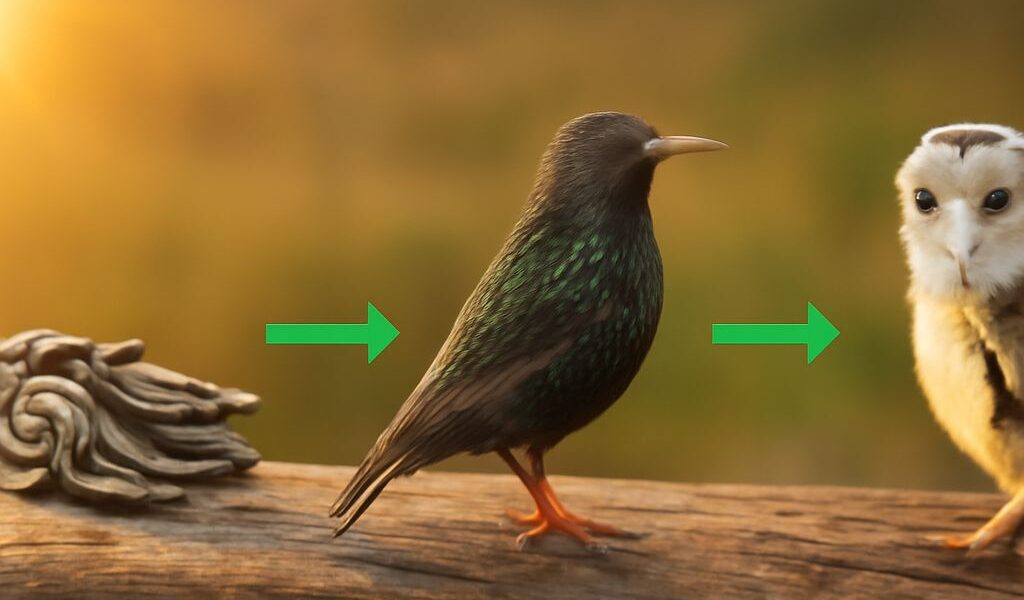
Grass → vole → barn owl
- Grass: The producer captures solar energy through photosynthesis.
- Vole: The primary consumer eats plant material, including grasses and seeds.
- Barn owl: The secondary consumer receives energy by eating the vole.
This chain is correct for a common grassland feeding pathway, but it is not a complete description of barn owl ecology. Barn owls often hunt where small mammals are abundant, so the available prey can change the pathway from one season or habitat to another.
Building a Barn Owl Food Web: Alternate Prey, Competitors, Predators, Scavengers, and Decomposers
We build the web by adding organisms that share food or transfer energy through different routes:
- Alternate prey: Grass and seeds feed mice, while plants also support insects. A barn owl may eat the mouse, or a shrew may eat insects before the owl eats the shrew. Small birds, frogs, rats, and young rabbits create additional pathways.
- Competitors: Kestrels, short-eared owls, snakes, and foxes may use some of the same small-mammal prey. Competition becomes stronger when food is scarce.
- Predators: Great horned owls and large eagles may prey on barn owls in some regions. Foxes and raccoons can also threaten eggs or nestlings. The barn owl is therefore not the endpoint of every relationship.
- Scavengers: Crows, magpies, foxes, and carrion beetles can feed on dead animals, including uneaten prey or carcasses left by predators.
- Decomposers: Fungi and bacteria break down dead plants, prey, and waste. They return nutrients to the soil, where plants can use them again.
Energy flows through these links and is gradually lost as heat. Nutrients, unlike energy, can cycle back through decomposers and soil to support new plant growth.
What Changes When One Population Shifts
If grass production falls because of drought, voles and mice may decline. Barn owls then face less food, may switch to alternate prey, or may produce fewer young. Their competitors may also struggle because they use some of the same prey.
If vole numbers rise, barn owls may find hunting easier, while foxes, snakes, and other vole predators also gain more food. If barn owl numbers fall, pressure on voles may weaken, but other predators can limit how much the vole population grows. These linked responses are why a food web explains ecosystem change more realistically than a single food chain.